![Best Dough Sheeter Machine for Home Bakers & Small Bakeries [Buyer’s Guide]](http://doughrollermachine.com/cdn/shop/articles/electric-dough-sheeter-machine3_712ce57e-8491-4e8a-a57b-7a269e237829.webp?v=1775472141&width=1100)
Best Dough Sheeter Machine for Home Bakers & Small Bakeries [Buyer’s Guide]
Why a Dough Sheeter Machine Is a Game-Changer
If you’ve ever rolled out pizza or pastry dough by hand, you know the struggle: it’s slow, uneven, and exhausting — especially when you’re baking more than one batch. That’s where a dough sheeter machine changes everything.
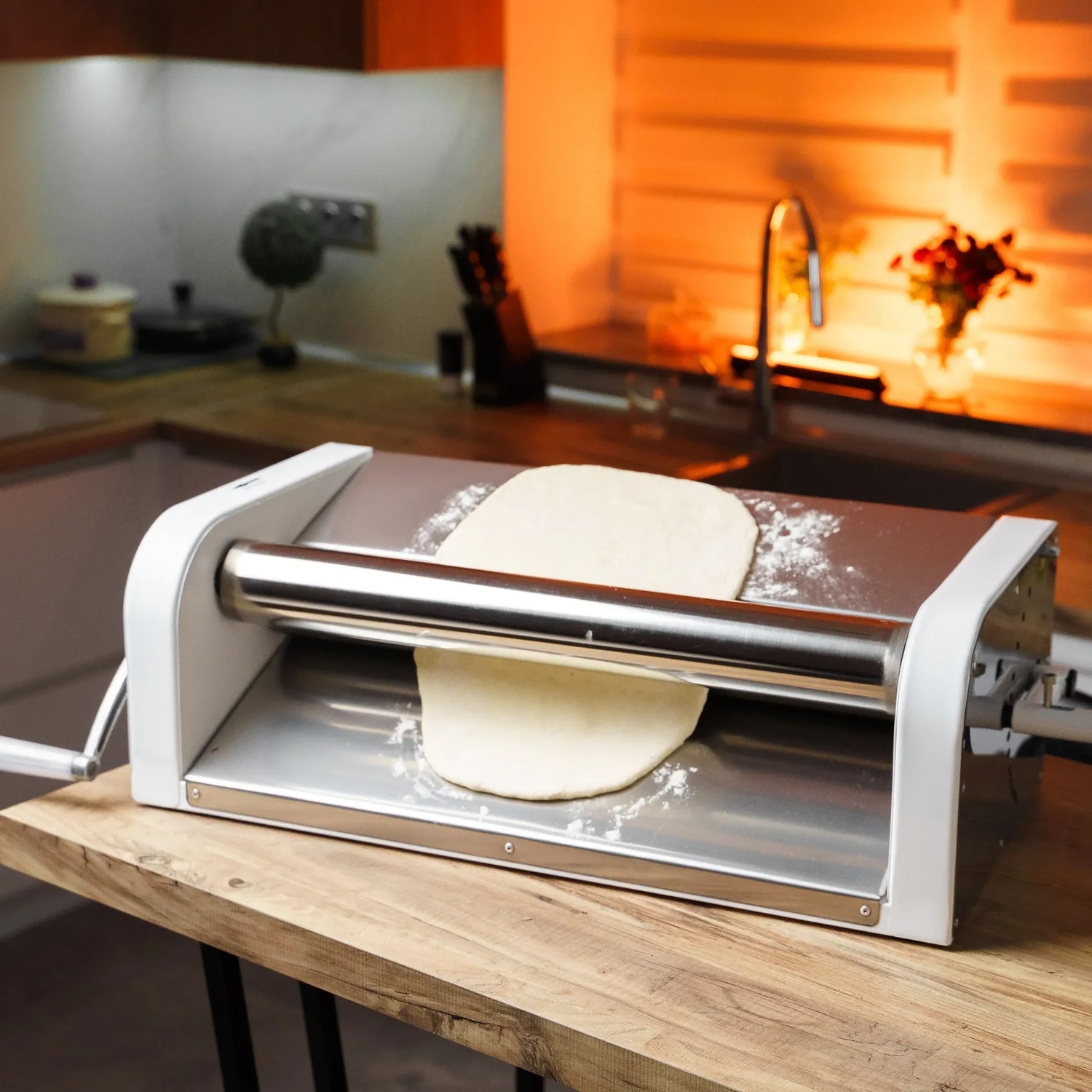
In simple terms, a dough sheeter machine (often searched as a dough roller machine) flattens dough into consistent sheets in seconds. No more guesswork. No more arm workout.
This guide is written primarily for home bakers looking for the best dough sheeter for home use. We also cover small bakeries and compact prep setups that need countertop equipment — without going into large floor-standing industrial machines.

Whether you’re doing weekly pizza nights at home or prepping pastry in a small café, the right machine can save time, improve results, and make dough prep smoother than ever.
In this guide, we’ll compare manual vs electric dough sheeters and help you choose the best option for your kitchen setup and budget.
👉 Browse all models in our dough sheeter machines collection.
Who Actually Needs a Dough Sheeter (and Who Doesn’t)?
Not everyone needs a dough sheeter — but for some, it’s a total game-changer.
You’ll benefit from a dough sheeter machine if:
- You bake pizza, pastry, or bread multiple times a week
- You run a small bakery, café, food truck, or pizzeria
- You make tortillas, flatbreads, croissants, or laminated doughs in batches
- You want to save time and get even results every single time
If you only bake occasionally (once a month) or enjoy rolling one pizza by hand, a sheeter may be optional. But many home bakers find even a manual dough sheeter is a major upgrade for consistent results without the effort.
Dough Roller Machine for Home vs Dough Sheeter – What’s the Difference?
If you’re searching for a dough roller machine for home, you’ll often land on dough sheeters — because in home and countertop-sized equipment, these terms overlap.
A dough sheeter feeds dough between adjustable rollers to create an even sheet. Many shoppers call that same countertop unit a dough roller machine or home dough sheeter, especially when the use case is pizza or pastry.
The practical difference usually comes down to workflow and volume:
- Home baking / small batches: a compact dough sheeter machine is the most common “dough roller” style you’ll see.
- Higher volume production: true commercial rollers can be larger and specialized — but that’s outside the scope of this guide.
For most home kitchens and small prep stations, the best starting point is the dough sheeter machines collection and picking manual vs electric based on your routine.
Dough Sheeter Basics – How These Machines Work
A dough sheeter machine flattens dough into thin, even sheets — whether it’s for pizza, puff pastry, croissants, or tortillas. Instead of using a rolling pin, you feed dough between two rollers. The rollers apply even pressure and are adjustable, so you can set your desired thickness.
These machines are sometimes called dough roller machines or pizza dough sheeters, and they do the same core job: make dough sheets that are smooth, symmetrical, and ready to cut, shape, or bake.

Types of Dough Sheeter Machines
There are two main types of sheeters you’ll come across:
-
Manual Dough Sheeter:
Uses a hand crank — no electricity required. Great for home kitchens, food trucks, or very small prep needs. -
Electric Dough Sheeter:
Powered by a motor. Faster, more consistent, and better for kitchens that handle larger batches daily.
In this guide we focus on compact countertop models for home bakers and small bakeries — not bulky floor-standing units.
Manual vs Electric Dough Sheeter – Which Style Fits You?
Choosing between a manual dough sheeter and an electric dough sheeter depends on how much you bake, your space, and your budget. Here’s a breakdown to help you decide.
Manual Dough Sheeter – Pros & Cons
Pros:
- Doesn’t require electricity — ideal for home kitchens, markets, and mobile setups
- Simple mechanical design = less to break
- Lightweight and easier to store
- Lower upfront cost (great if you want a strong manual option without a motor)
Cons:
- Requires physical effort to crank
- Slower for large batches
- Consistency can drop when volume increases
Manual sheeters are ideal for home bakers, food trucks, and anyone prepping dough weekly who wants more consistency than a rolling pin.
👉 See the manual dough sheeter machine.
Electric Dough Sheeter – Pros & Cons
Pros:
- Motorized rollers = faster and more efficient
- More consistent thickness pass after pass
- Great for laminated doughs (croissants, puff pastry)
- Handles higher volume more comfortably
Cons:
- Higher cost than manual models
- Requires power (110V or 220V depending on model)
- Heavier and less portable
Electric models are best for busy home kitchens (frequent baking) and very small bakeries that need speed and consistency without going industrial.
👉 See the electric dough sheeter machine.
Quick Comparison Table
|
Feature |
Manual Dough Sheeter |
Electric Dough Sheeter |
|
Best for |
Home bakers, food trucks, small batches |
Busy home kitchens, very small bakeries, batch prep |
|
Home use suitability |
⭐⭐⭐⭐ (top pick for most homes) |
⭐⭐⭐ (best if you bake often) |
|
Speed & volume |
Medium (smaller runs) |
High (continuous batches) |
|
Effort |
Hand crank (some physical work) |
Minimal effort |
|
Power |
No electricity needed |
110V / 220V required |
|
Maintenance |
Very low |
Low (motor/drive components) |
If you want a deeper, step-by-step checklist for choosing the best dough sheeter for home use, check our buyer’s guide (sizes, thickness range, and what matters most for home kitchens).
Key Features to Look For in the Best Dough Sheeter Machine
If you’re aiming for the best dough sheeter for home use (or a compact unit for a small bakery), focus on these practical specs.
Roller Width & Size (15.7” vs 19.7”)
The wider the rollers, the more dough you can sheet at once.
- 15.7”: ideal for home kitchens and light commercial use — fits most countertops and handles pizza, pasta, and pastry.
- 19.7”: better for larger dough portions, bigger pizza bases, and laminated pastries.
Larger rollers help avoid reworking dough multiple times, saving time and maintaining dough texture.

Thickness Range & Adjustability
Look for a machine with a wide thickness range. The best models offer:
- Adjustable settings from 0.7 mm to 20–30 mm
- Smooth controls for fine-tuning — thin for pasta, thicker for cookies or focaccia
This is essential for getting even dough sheets every time.
Capacity & Throughput (What It Means in Real Life)
- A good electric unit can process up to 38 lbs of dough per hour
- That’s roughly 70 pizza bases or dozens of croissants in a prep session
- Manual models are better for smaller, less frequent batches
Countertop Space & Storage
- Most compact models are around 25” x 13”
- They fit standard kitchen or bakery counters
- Manual models are easier to move/store
If your space is limited, start by browsing the dough sheeter machines collection.
Build Quality & Ease of Cleaning
- Stainless steel rollers and frame = durability and easier maintenance
- Avoid belt-driven designs when possible — chain-drive sheeters are typically more reliable
- Open access = faster wipe-down after use
Our Recommended Dough Sheeter Machines for Home Bakers & Small Bakeries
If you want two safe picks without overthinking it, these cover most needs — from weekend pizza at home to daily prep in a small kitchen.
Best Electric Dough Sheeter for Busy Home Kitchens & Very Small Bakeries
Product: Electric Dough Sheeter Machine
This model is built for efficiency. It’s a strong choice if you’re prepping dough often — pizza, pastries, croissants, or pasta.
Why bakers choose it:
- Choose 15.7” or 19.7” roller widths
- Works on 110V or 220V (depending on your setup)
- Up to 38 lbs/hour throughput
- Compact countertop footprint
- Stainless rollers for easier cleaning
🔗 See details and specs → electric dough sheeter machine
Best Manual Dough Sheeter for Home Kitchens & Food Trucks
Product: Manual Dough Sheeter Machine
No electricity? No problem. This hand-crank machine is perfect for smaller batches and mobile setups — and it’s often the best value for home use.
Why it’s a top pick:
- Available in 15.7” and 19.7” roller widths
- Adjustable from 0.7 mm to 30 mm
- Compact and portable
- Quiet operation and low maintenance
- All-metal build with stainless rollers
🔗 Check the manual dough sheeter machine.
How to Choose the Right Dough Sheeter for Your Kitchen (Decision Guide)
Not sure whether you need a manual or electric dough sheeter? This quick guide helps you decide fast.
Step 1: How Often Do You Bake?
- Once a week or less → Manual is usually enough for home baking.
- Daily or high-volume prep → Go electric to save time and effort.
Step 2: What Are You Making?
- Pizza, pasta, tortillas, cookies → both work well.
- Laminated pastries (croissants, puff pastry) → electric makes repeated passes easier.
Step 3: How Much Space Do You Have?
- Tight space → manual is lighter and easier to store.
- Dedicated prep area → electric is easier for frequent use.
Step 4: Power Access & Budget
- No outlet / mobile setup → manual.
- Standard home outlet (110V) → electric can work fine for frequent baking.
- Commercial kitchen (220V) → electric is the practical choice.
Mini-Scenarios: What’s Right for You?

-
Home pizza nights + occasional pastries?
→ Manual or a compact 15.7” electric model (browse the dough sheeter machines collection). -
Small bakery prepping croissants daily?
→ Electric (19.7” if you want more width) — see the electric dough sheeter machine. -
Food truck / market setup?
→ Manual (no power needed) — see the manual dough sheeter machine.
FAQ – Common Questions About Dough Sheeter Machines
Quick answers to the most common questions home bakers and small bakery owners ask before buying a dough sheeter.
What is the best dough sheeter for home use?
For most home bakers, a manual dough sheeter machine is the best starting point: it’s compact, affordable, and delivers consistent dough thickness without needing power. If you bake frequently or do large batches, consider an electric dough sheeter machine.
Is a manual dough sheeter enough for home baking?
Yes — if you make pizza, pastry, pasta, or tortillas weekly, a manual model is usually plenty. It’s also the simplest way to get even dough sheets without upgrading to a motorized unit.
Is a dough sheeter worth it for home bakers?
Yes — if you bake weekly, a dough sheeter saves time and improves consistency. Manual models are especially great for home use.
Can I use a dough sheeter for pizza dough, puff pastry, and croissants?
Absolutely. These machines handle many dough types — including higher-hydration pizza dough and laminated pastry dough. For frequent laminated dough work, electric can make repeated passes easier.
What’s the difference between a dough roller and a dough sheeter?
In countertop and home contexts, people often use the terms interchangeably. A dough sheeter feeds dough between adjustable rollers to create an even sheet — which is exactly what many shoppers mean by a “dough roller machine.”
Can I use a dough sheeter for fondant or cookie dough?
Yes. As long as the dough isn’t extremely sticky or rock-hard cold, a sheeter works well for cookie dough and fondant. Light flouring helps prevent sticking.
How thick should pizza dough be when using a sheeter?
It depends on the style:
- Thin crust pizza → 2–3 mm
- Neapolitan-style → 3–4 mm
Do I need a commercial dough sheeter or is a countertop model enough?
Unless you’re producing very large volumes daily, a compact countertop dough sheeter is typically enough for a home kitchen or small bakery. Browse options in the dough sheeter machines collection.
Ready to pick a model? Start here: shop dough sheeter machines.