
How to Use a Dough Sheeter Machine Step by Step (Pizza, Pastry, Tortillas & More)
Why a Dough Sheeter Changes the Game
Rolling dough by hand sounds simple — until you’re doing it over and over, trying to get the same thickness each time. It’s time-consuming, inconsistent, and exhausting, especially when baking in batches or prepping for a small business.
That’s exactly why dough sheeter machines exist. Whether manual or electric, these tools flatten dough to a consistent thickness in seconds, giving you smooth, uniform sheets for pizza, pastry, tortillas, pasta, and more.
In this guide, we’ll walk you through how to use a dough sheeter machine step by step, including setup, prep, thickness settings, and dough-specific tips — whether you’re using a home model or a commercial unit.
👉 Looking for a dough sheeter for your kitchen?
Types of Dough Sheeter Machines (Manual vs Electric)

Not all dough sheeters are built the same — and that’s a good thing. Depending on your kitchen size, how often you bake, and the volume you need to prep, you’ll want to choose between manual and electric models.
Manual Dough Sheeter Machines
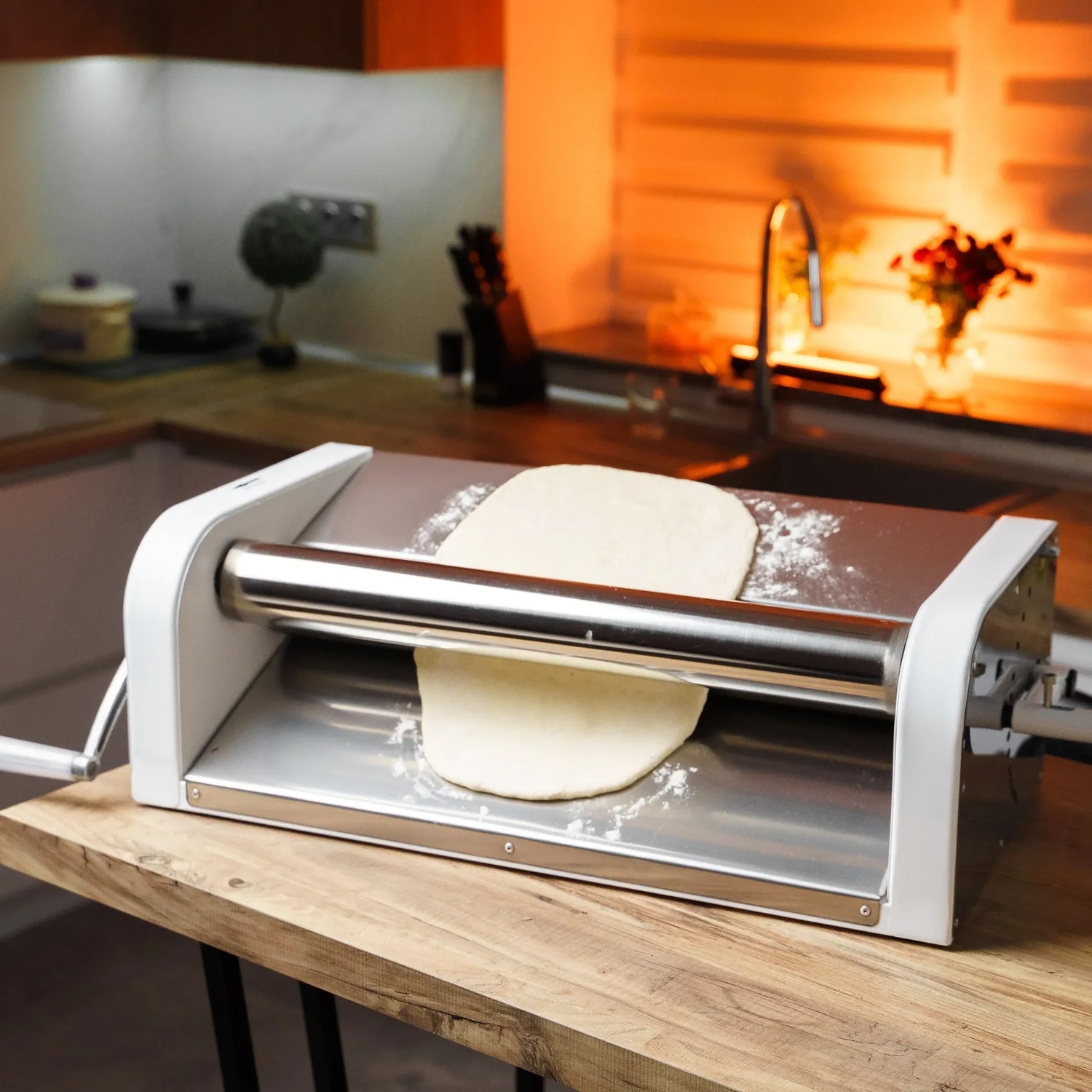
A manual dough sheeter is operated by turning a hand crank. It uses mechanical rollers to flatten dough and gives you full control over the rolling process.
These machines are:
- Lightweight and portable
- Great for small kitchens, food trucks, and home bakers
- Perfect for occasional baking or low-batch production
They don’t require any electricity — just a bit of arm power.
🔗 Check out our Manual Dough Sheeter Machine
Electric Dough Sheeter Machines
An electric dough sheeter uses a built-in motor to pull the dough through the rollers automatically. It’s much faster and better for repeated, high-volume use.
Best for:
- Bakeries, restaurants, and pizza shops
- Kitchens where speed and consistency matter
- Daily prep of croissants, puff pastry, tortillas, and pizza dough
While they cost more upfront, electric models save time, reduce labor, and increase output dramatically.
🔗 Explore the Electric Dough Sheeter Machine
Manual vs Electric Dough Sheeter – Quick Comparison
|
Feature |
Manual Dough Sheeter |
Electric Dough Sheeter |
|
Best for |
Home kitchens, food trucks |
Restaurants, bakeries, high output |
|
Speed |
Moderate, hand-cranked |
Fast and automatic |
|
Power Required |
None |
110V / 220V |
|
Control |
High (manual pressure control) |
Consistent with motor power |
|
Noise |
Silent |
Low-to-moderate hum |
|
Cost |
Lower |
Higher upfront, long-term ROI |
|
Ideal Use Cases |
Pizza nights, pastries, small batches |
Laminated dough, tortillas, large volume |
Before You Start – Setup, Safety & Dough Prep
Whether you’re working with a manual dough sheeter or an electric dough roller machine, proper setup and dough preparation are key to getting clean, even sheets and extending the life of your equipment.
Machine Setup Checklist

Before your first use:
- Unpack carefully and remove all protective packaging.
- Place on a flat, stable, non-slip surface — ideally a heavy countertop or work table.
-
For electric models:
- Check the voltage (110V for home, 220V for commercial).
- Plug into a grounded outlet away from water sources.
- Remove protective film from the rollers and wipe down surfaces with a dry or slightly damp cloth (no soap, no direct water).
Dough Sheeter Safety Tips
Dough sheeters are safe when used properly — but like any kitchen equipment with moving parts, attention matters.
Always:
- Keep hands and utensils away from the rollers when the machine is operating.
- Tie back long hair and avoid loose clothing or jewelry.
- Never insert dough while the rollers are closing or in motion (electric).
- Unplug electric models before cleaning or servicing.
- Supervise use if operating in shared or family spaces.
Dough Preparation Tips (Before Rolling)
The quality of your dough matters just as much as the machine.
- Let dough rest for 15–20 minutes after kneading — relaxed gluten = smoother rolling.
- Bring dough to room temperature before using the sheeter (cold dough is harder to flatten).
- Portion dough balls by weight for consistent sheet sizes.
-
Use:
- Light flour for drier doughs (like pastry or pasta)
- Light oil for wetter doughs (like high-hydration pizza or sticky flatbread doughs)
- Don’t overflour — it can cause slipping or uneven texture.
With everything prepped and ready, you’re set to roll.
Step-by-Step – How to Use a Dough Sheeter Machine
Using a dough sheeter might feel intimidating at first, but once you try it, you’ll realize it’s actually one of the simplest — and most satisfying — tools in a baker’s kitchen.
The process is nearly identical whether you’re using a manual dough roller or an electric dough sheeter. The only difference? One requires a crank, the other uses a motor.
Basic Operating Steps (Applies to Both Manual & Electric)

- Dough being fed into the machine at the widest setting
- Rolling process mid-way
- Final thin sheet coming out of rollers
Follow these steps to roll your dough smoothly and evenly:
-
Set the roller thickness knob to the widest setting.
This is your starting point — you’ll gradually reduce thickness from here.
-
Lightly dust the rollers and dough (optional).
Use a little flour or oil depending on your dough type. This helps reduce sticking without affecting the dough texture.
-
Flatten the dough ball into a rough disk or rectangle by hand.
This ensures the dough feeds through evenly on the first pass.
- Feed the dough through the rollers.
- Manual: Turn the hand crank while gently guiding the dough in.
-
Electric: Let the motor pull it through (keep fingers clear!).
-
Fold and re-roll if needed.
If the shape isn’t even, fold the dough in thirds like a letter and roll again. This evens out edges and improves structure.
-
Gradually reduce the roller gap and repeat.
Decrease thickness one setting at a time. Too much at once can tear the dough.
-
Stop when you reach your desired thickness.
Use a ruler or visual check to confirm. See the guide below for exact settings.
-
Cut, portion, or shape the sheeted dough as needed.
Whether you’re making pizza, croissants, or tortillas — now you’ve got a perfect base.
🔧 These instructions work for all dough types — but each one has a unique ideal thickness. Up next, we’ll show you the best settings for pizza, pasta, pastry, and more.
How to Use a Dough Sheeter for Specific Foods
Whether you’re prepping dough for pizza night at home or producing dozens of croissants in a bakery, your sheeter can deliver flawless results — if you know how to use it right for each dough type.
Using a Dough Sheeter for Pizza Dough
What to know:
- Pizza dough has high hydration and gluten strength — meaning it stretches but also springs back.
- Ideal hydration: 58–65% (Neapolitan-style may go up to 70%).
How to roll it:
- Pre-shape dough into a ball and rest it for 15–20 minutes.
- Flatten slightly by hand, then pass through the rollers at a wide setting.
- Gradually decrease thickness to 2–4 mm, depending on style.
- Use your hands or knuckles to stretch it into a round shape, preserving edge thickness for the crust.
🔑 Avoid overworking — too many passes can make the dough tough or elastic.
Using a Dough Sheeter for Pastry, Croissants & Puff Dough

Why sheeters are ideal:
- These doughs are laminated (butter folded into layers).
- Rolling by hand can warm the dough and ruin the lamination.
Best practices:
- Chill the dough and butter between every fold.
- Use 3–5 mm thickness per fold.
- Keep flour light — too much interferes with layer bonding.
- After final fold, reduce to 1–2 mm for puff pastry or croissant shaping.
Using a Dough Sheeter for Tortillas & Flatbreads
What makes tortillas tricky:
- You need a consistent thickness for even cooking.
- Dough balls must be evenly sized for best results.
How to roll:
- Portion dough into small, equal balls.
- Set roller to 1.5–2 mm.
- Pass once or twice — overworking creates dryness.
- Use immediately or stack between parchment if storing.
Tip: Use minimal flour or brush the rollers with a drop of oil to prevent sticking.
Using a Dough Sheeter for Pasta & Noodles
Why choose a sheeter over a pasta machine:
- Much faster and more consistent
- Can handle larger batches in seconds
How to roll pasta:
- Flatten dough slightly and pass through wide setting.
- Reduce gradually until you reach:
-
- Lasagna: ~1.2–1.5 mm
- Ravioli: ~0.7–1 mm
- Tagliatelle/Fettuccine: ~1–1.2 mm
3. Dust lightly with semolina to prevent sticking.
4. Cut by hand or with a pasta cutter.
Tip: If making filled pasta, avoid overflouring to help dough stick together when sealing.
Cleaning, Maintenance & Daily Care
Taking care of your dough sheeter isn’t complicated — but doing it right can extend its lifespan and keep every batch of dough clean, safe, and professional-quality.
How to Clean a Dough Sheeter (Step by Step)
Whether you’re using a manual model or an electric dough sheeter, cleaning should always be part of your daily routine.
Important:
Always unplug electric machines before cleaning and wait until all moving parts have stopped completely.
Here’s how to do it safely:
- Turn off and unplug (electric models).
- Wipe the rollers with a dry or slightly damp cloth. Do not use water directly.
- Remove stuck-on dough with a plastic scraper or soft-bristle brush.
- Avoid metal tools that could scratch the rollers or surface.
- Wipe the exterior with a damp cloth if needed.
- Let everything air dry before the next use.
Maintenance Tips for Smooth Operation
Regular care keeps your sheeter consistent and reliable — whether at home or in a busy kitchen.
After Every Use:
- Wipe rollers
- Remove crumbs or dough pieces
- Inspect for stuck dough near gears or levers
Weekly:
- Check tension on the roller knobs and crank (manual)
- Inspect the chain/belt and motor casing (electric models)
Monthly (or after heavy use):
- Apply food-safe oil to exposed metal parts (if needed)
- Clean or replace felt guards if included
Troubleshooting – Common Problems & Fixes
Even the best dough sheeter machines can run into hiccups — but the fix is usually quick and easy. Here’s how to solve the most common problems without frustration or damage.
❌ Dough Sticks to the Rollers
What’s going wrong:
- Dough is too wet or overhydrated
- Rollers weren’t cleaned from previous use
- Too little flour or oil used on surface
Quick fix:
- Lightly dust the dough or rollers with flour (or brush with a little oil for sticky doughs)
- Let dough rest longer before rolling
- Clean rollers thoroughly and try again
❌ Dough Tears or Rips in the Machine
What’s going wrong:
- You’re reducing the roller gap too quickly
- Dough is too cold, stiff, or under-kneaded
Quick fix:
- Gradually decrease thickness one setting at a time
- Let the dough rest at room temperature for 15–20 minutes
- Fold and re-roll to reinforce weak areas
❌ Uneven Thickness Across the Sheet
What’s going wrong:
- Dough wasn’t centered or was fed in unevenly
- You’re not rotating or folding the dough between passes
Quick fix:
- Center the dough every time before inserting
- Rotate dough 90° between passes
- Fold in thirds (like a letter) if edges are thinning faster than the middle
❌ Machine Makes Noise (Electric Models)
What’s going wrong:
- Machine isn’t sitting on a stable surface
- Chain may need lubrication
Quick fix:
- Move the sheeter to a sturdier surface
- Check if any parts are loose
- If noise persists, apply food-safe lubricant to moving components (as recommended by manufacturer)
❌ Dough Shrinks Back After Rolling
What’s going wrong:
- Dough hasn’t rested enough
- Gluten is too tight
Quick fix:
- Let dough sit covered for 15–30 minutes after kneading
- Avoid overworking with too many passes
When a Dough Sheeter Is Worth It (and Which One to Choose)
Buying a dough sheeter isn’t just about convenience — it’s about consistency, time savings, and better results. Whether you’re a weekend baker or running a small food business, here’s when investing in a sheeter makes real sense.
💡 Is a Dough Sheeter Worth It for Home Bakers?
Yes — if you:
- Bake pizza, pastries, or pasta regularly
- Want faster, more even results without the arm workout
- Struggle with rolling dough to consistent thickness
- Value clean, pro-quality sheets for layered pastries or thin crust pizza
If that sounds like you, a manual dough sheeter is often the best place to start — compact, affordable, and reliable.
🔗 Explore our Manual Dough Sheeter Machine
Is a Dough Sheeter Worth It for Small Businesses?
Absolutely. For bakeries, pizzerias, food trucks, and cafés, time is money. A commercial-grade electric dough sheeter speeds up prep, reduces labor, and gives consistent results every time.
You’ll benefit most if:
- You roll dough daily or in large batches
- Your team needs to standardize product sizes and thickness
- You make croissants, puff pastry, or pizza professionally
🔗 Check out the Electric Dough Sheeter Machine for heavy use
Manual vs Electric — Which One Should You Choose?
|
Feature |
Manual Sheeter |
Electric Sheeter |
|
Best For |
Home baking, low-volume kitchens |
Commercial use, restaurants, bakeries |
|
Power Needed |
None |
110V or 220V |
|
Speed |
Medium – hand-cranked |
Fast – motor powered |
|
Price |
Lower cost |
Higher upfront, better ROI long-term |
|
Consistency |
Good |
Excellent, especially for fine doughs |
|
Portability |
Lightweight, compact |
Heavier, not ideal for mobile setups |
Final Recommendation
- Start with manual if you bake occasionally, are on a budget, or want portability.
- Upgrade to electric if you bake daily, value speed and consistency, or need to keep up with high demand.
👉 Still not sure?
Browse all models in our Dough Sheeter Machines Collection to compare features and find the perfect fit.
FAQ – Quick Answers for First-Time Users
How hard is it to use a dough sheeter for the first time?
Not hard at all. Most models are beginner-friendly — just set the thickness, flatten your dough slightly, and feed it through. After a few tries, it becomes second nature. For electric models, the motor handles most of the work.
Can I use a dough sheeter for sticky or high-hydration doughs?
Yes, but with a few tweaks. Let the dough rest longer, reduce hydration slightly, and dust with minimal flour or oil the rollers. Rested dough is less likely to stick or tear during rolling.
Do I still need a rolling pin if I have a dough sheeter?
Not really — the sheeter replaces most tasks you’d use a pin for. But some bakers still like finishing certain shapes or stretching pizza dough by hand after rolling for that final touch.
Is a dough sheeter worth it for home use?
If you bake often — especially pizza, pastries, or pasta — a dough sheeter saves time, reduces physical effort, and improves consistency. A manual model is great for home bakers, while electric is better for heavy use.
Can I use the same dough sheeter for pizza, pastry, and pasta?
Absolutely. Just adjust the thickness setting to suit each type of dough. Many bakeries and restaurants use one machine to prep everything from tortillas to croissants.
How thin can a dough sheeter roll dough?
Most sheeters roll down to 0.7 mm, which is perfect for pasta, puff pastry, and crackers. You can gradually adjust thickness in small steps for full control.
How often do I need to clean my dough sheeter?
Clean it after every use — wipe the rollers, remove dough bits, and check for buildup. For electric models, never wash with water near the motor or chain. A dry or slightly damp cloth works best.
What voltage do electric sheeters need?
Most machines are available in 110V for standard kitchens and 220V for commercial setups. Always check your power source before ordering.