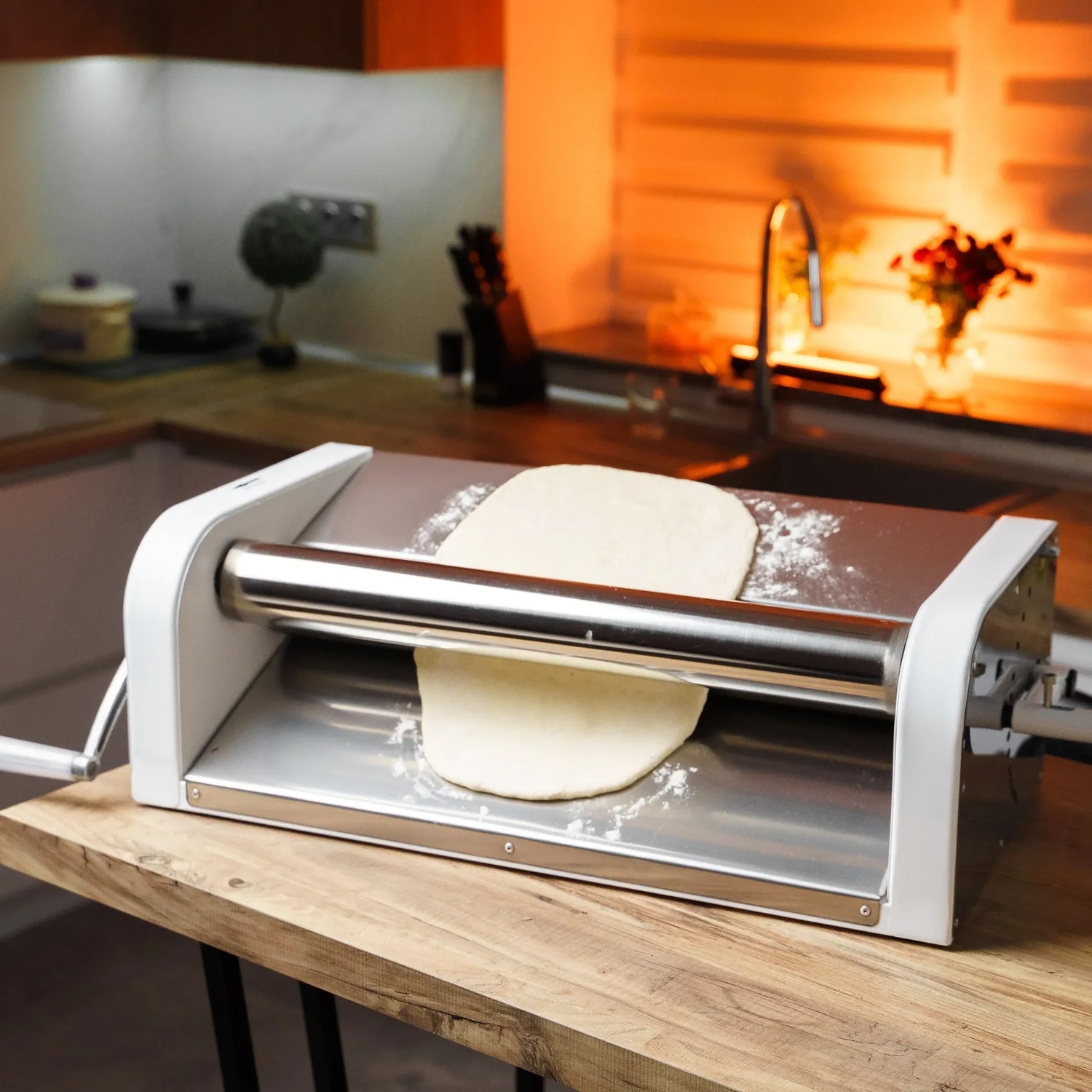


How to Roll Dough Evenly for Pizza, Pastry & Bread (With or Without a Dough Sheeter)
Why Even Dough Thickness Matters
If you’ve ever baked a pizza with burnt edges and a soggy middle — or made pastry that puffed unevenly — you’ve already learned the hard truth: rolling dough evenly is everything.
Whether you’re making pizza, croissants, bread, or puff pastry, uneven dough means uneven results. One part overcooks. One part underbakes. And instead of that beautiful rise or golden finish, you’re left guessing what went wrong.
The secret? Consistent dough thickness. And no, it’s not about rolling faster — it’s about rolling smarter.
Home bakers and professionals alike have two options:
- You can roll dough by hand (we’ll show you exactly how to do it right)
- Or you can use a dough sheeter machine for fast, flawless results every time

This guide covers both. Whether you’re using a rolling pin or ready to upgrade to a dough roller, we’ll show you how to flatten dough evenly, avoid common mistakes, and dial in the perfect thickness for every recipe.
👉 Want bakery-level consistency at home? Explore our dough sheeter machines and see what’s possible.
Before You Start — The Secret Is in Dough Prep
Here’s the truth most people don’t realize: if your dough isn’t prepped properly, no amount of rolling will make it even. Struggling to get a flat sheet? It’s not your technique — it’s your dough.
Before you even touch a roller or dough sheeter, you need to get the dough consistency right. That means proper resting, the right temperature, and just enough flour to keep things smooth — not stiff.

✅ Here’s how to set yourself up for rolling success:
-
Let your dough rest for 15–20 minutes
This relaxes the gluten and makes the dough easier to stretch evenly, without springing back. -
Keep your dough at room temperature
Cold dough is stiff and cracks. Warm dough gets sticky and tears. Aim for 68–72°F (20–22°C). -
Use minimal flour on your work surface
Too much flour makes dough dry and resistant to stretching. Use just enough to prevent sticking. -
Lightly oil your hands if needed
Especially helpful for pizza or bread dough — it reduces drag and helps you flatten dough smoothly. -
Weigh and portion your dough balls
Use a digital scale to keep portions equal. That way, your sheets roll out to the same size and thickness.
Method 1 — Rolling Dough Evenly With a Dough Sheeter Machine
If you want perfectly even dough with zero guesswork, a dough sheeter machine is your best friend. This is the tool professionals use to roll pastry, pizza, pasta, croissants, and more — fast, smooth, and consistent.
Whether you’re using a manual model or a motorized electric dough sheeter, the steps are mostly the same.
Step-by-Step: How to Use a Dough Sheeter
-
Lightly dust the rollers (optional)
Some dough types — like puff pastry or croissant dough — benefit from a light dusting to prevent sticking. Others may not need it at all.
-
Start with a wide roller gap
Set the rollers to the widest setting. You don’t want to over-stretch the dough on the first pass.
-
Pass the dough through once
Gently feed the dough into the rollers. Let it come out the other side without pulling or forcing it.
-
Reduce thickness gradually
After each pass, reduce the roller gap by one setting. This prevents tearing and keeps your dough structure intact.
-
Rotate the dough between passes
This keeps the shape even and ensures you’re not rolling in just one direction.
-
Finish with a final pass at desired thickness
Once your dough is nearly there, do one last pass for that perfect finish — smooth, even, and ready to cut or shape.
👉 Try it with our Electric Dough Sheeter for fast, hands-free rolling — or use the Manual Dough Sheeter for full control in a small kitchen.
Ideal Thickness Settings for Different Doughs
Chef-tested thickness chart for common recipes
|
Dough Type |
Ideal Thickness |
Notes |
|
Pizza (New York-style) |
2–3 mm |
Thin and crisp; ideal for fast baking |
|
Pizza (Neapolitan) |
3–4 mm |
Slightly thicker edge (cornicione) |
|
Croissant Dough |
3–5 mm (per fold) |
Use multiple folds; chill between passes |
|
Puff Pastry |
1–2 mm |
Needs ultra-fine layering |
|
Pasta Sheets |
0.7–1.5 mm |
Ravioli = thinner, lasagna = thicker |
|
Tortillas / Flatbreads |
1–2 mm |
Even thickness ensures even cooking |
|
Cookie Dough |
4–6 mm |
For uniform baking and cutter precision |
Whether you’re running a bakery or perfecting dough at home, rolling dough with a dough sheeter ensures results that are nearly impossible to get by hand — fast, clean, and repeatable.
Method 2 — How to Roll Dough Evenly Without a Dough Sheeter
You don’t need a fancy machine to roll dough evenly. With a little technique and the right tools (even improvised ones), you can still get bakery-level results at home.
Whether you’re using a classic rolling pin, a makeshift roller, or just your hands, here’s how to make it work — no sheeter required.
Step-by-Step: Rolling Dough With a Rolling Pin
-
Lightly flour your work surface
Use just enough flour to prevent sticking — not so much that the dough gets dry or stiff.
-
Start from the center
Place your pin in the middle and roll outward in all directions. Don’t press too hard — let the dough guide you.
-
Rotate the dough 90° every few passes
This helps you roll it evenly into a round or rectangle, depending on what you need.
-
Keep your pressure consistent
Uneven pressure = uneven dough. Keep your hands even and your movements smooth.
-
Check thickness regularly
Use your fingers or a ruler to gauge thickness as you go. If one side is thicker, roll only that part gently.
-
Trim edges if needed
Especially with pastry dough, trimming the edges can help create clean lines and even baking.
How to Roll Dough Evenly Without a Rolling Pin (Home Hacks)

No rolling pin? No problem. Here are a few clever tools you probably already have in your kitchen:
- A wine bottle — Smooth, cylindrical, and heavy enough to roll dough evenly. Clean it and use the side.
- A glass jar — Works like a short rolling pin. Great for cookies or small pastry sheets.
- A stainless steel tumbler — Cold and easy to grip, great for rolling chilled doughs.
- Your hands or knuckles — Especially useful for pizza dough. Stretch from the center out.
- A silicone mat with guides — Helps you maintain even thickness if you’re using a pin or bottle.
- Flat-bottomed pot — Good for pressing and flattening tortilla or roti dough balls.
If you’re rolling dough by hand, it takes more attention — but with these techniques and tools, it’s absolutely possible to flatten dough evenly for pizza, pastry, bread, or cookies.
Common Mistakes That Lead to Uneven Dough
Even experienced bakers can end up with uneven dough — too thick in one spot, too thin in another, and not rolling out the way it should. If you’ve been fighting your dough or getting inconsistent results, here’s what might be going wrong (and how to fix it).
❌ Mistake 1: Dough is too cold
Why it’s a problem: Cold dough is stiff and resists stretching. It snaps back when you roll it.
Fix: Let it rest at room temperature for 10–15 minutes before rolling.
❌ Mistake 2: Dough is too dry
Why it’s a problem: Dry dough cracks, tears, and rolls unevenly.
Fix: Lightly knead in a few drops of oil or water. Cover with a damp cloth to soften before rolling.
❌ Mistake 3: Using too much flour on the surface
Why it’s a problem: Excess flour creates friction and prevents smooth movement.
Fix: Use minimal flour — just enough to prevent sticking. Try a silicone mat for better control.
❌ Mistake 4: Pressing too hard
Why it’s a problem: Heavy pressure flattens some areas too much and leaves others thick.
Fix: Roll gently and evenly, starting from the center. Let the weight of the pin or tool do the work.
❌ Mistake 5: Not rotating the dough
Why it’s a problem: Rolling in one direction creates long, uneven shapes.
Fix: Rotate the dough 90° every few passes to maintain an even shape and thickness.
❌ Mistake 6: Skipping the dough rest
Why it’s a problem: Dough that hasn’t rested will resist shaping and snap back.
Fix: Always let dough rest after mixing and portioning. Resting = relaxed gluten = smoother rolling.
Master these dough rolling tips, and you’ll notice a huge difference in how easily your dough flattens — and how evenly it bakes.
Pizza, Pastry & Bread — Specific Rolling Techniques

How to Roll Pizza Dough Evenly
Rolling pizza dough evenly isn’t just about looks — it’s the secret to getting a crispy bottom and a soft, airy crust.
- Start by shaping with your hands: Flatten the dough gently from the center outward. Use your fingertips to create the base shape.
- Use knuckles to stretch: Lift the dough and drape it over your knuckles. Gently stretch it while rotating in the air. This keeps the center thin and avoids tearing.
- Don’t press the edges: Leave the rim untouched to allow the crust (cornicione) to puff in the oven.
- Finish with a light rolling pin touch (optional): If needed, use a few gentle rolls to adjust thickness evenly.
- Check thickness: Aim for about 2–4 mm depending on style (see our thickness chart above).
✅ Pro tip: For faster prep, a pizza dough sheeter gives perfect thickness in seconds — especially helpful if you’re making multiple pies.
How to Roll Pastry & Croissant Dough Evenly
Laminated doughs like croissants and puff pastry require precision — and patience.
- Always chill the dough between folds: Cold butter holds its shape and layers stay defined.
- Use long, even strokes: Avoid short, choppy rolling that can disturb layers.
- Flour lightly and evenly: Too much flour dries the dough, too little causes sticking.
- Rotate between passes: Keeps the sheet rectangular and layers aligned.
- Monitor thickness per fold: Aim for 3–5 mm per fold when rolling croissant dough.
✅ A pastry dough sheeter can dramatically improve consistency, especially when making dozens of croissants or puff pastry batches.
How to Roll Bread Dough Evenly
While bread dough isn’t usually rolled into sheets, it still needs even shaping — especially for sandwich loaves or filled rolls.
- Oil the surface instead of flouring: Bread dough is stickier. Oil prevents drag without drying it out.
- Flatten gently with your hands: Use palms to press the dough into a rectangle.
- Roll it into shape: For loaves, roll from the short side into a tight cylinder to ensure even rise.
- Check for bubbles: Gently press out large air pockets as you shape.
Even shaping = even baking = better rise, crumb, and crust.
When You Should Switch to a Dough Sheeter
There comes a point in every baker’s journey where a rolling pin just isn’t enough. If you’ve been spending more time flattening dough than actually baking with it, a dough sheeter can completely change your workflow — and your results.
Here’s when you know it’s time to upgrade:
✅ If You Bake Weekly
You’re not just baking for fun — you’re making pizza, pastry, or bread often. A manual dough sheeter saves time, reduces strain, and helps you achieve more consistent dough at home, even in a small kitchen.
✅ If You Bake Daily or Run a Business
For bakeries, pizzerias, and cafés, dough prep can eat up hours. An electric dough sheeter delivers perfect thickness in seconds — with no effort. That consistency improves quality and reduces mistakes.
✅ If You’re Making Croissants, Puff Pastry, or Laminated Dough
Even pressure and precise layers are critical. Sheeters take the stress out of rolling delicate, buttery dough and keep layers clean and sharp.
✅ If You’re Scaling Up or Selling Baked Goods
Higher volume means more hands or better tools. A dough sheeter gives you speed and consistency without needing a full kitchen staff.
Switching to a dough sheeter isn’t just a convenience — it’s a professional move that helps you bake faster, better, and with fewer errors.
👉 Ready to upgrade? Explore our dough sheeter machines here and find the right fit for your kitchen.
FAQ
1. How do I roll dough evenly without a rolling pin?
You can use a clean wine bottle, jar, tumbler, or even a flat-bottomed pan. Start from the center, roll outward in all directions, and rotate the dough every few passes. Use light, even pressure.
2. Why does my dough keep shrinking when I roll it?
That’s gluten at work. If the dough hasn’t rested long enough after kneading or chilling, it will snap back. Let it rest 15–20 minutes at room temperature to relax the gluten before rolling.
3. How thin should pizza dough be?
It depends on the style:
- New York-style: 2–3 mm
- Neapolitan: 3–4 mm
-
Thin-crust: 1.5–2 mm
A pizza dough sheeter makes it easy to get consistent results.
4. Why is my pastry dough tearing when rolled?
Either it’s too warm or too dry. Chill the dough between rolling steps, and use gentle, long strokes with minimal flour. If needed, lightly mist the dough with water and cover for a few minutes.
5. Can I use a dough sheeter for cookie dough?
Yes — it’s one of the easiest ways to get perfect thickness for cookies, especially if you’re cutting shapes or baking in batches. A dough sheeter ensures clean, even sheets.
6. What’s better: dough sheeter or rolling pin?
For small batches, a rolling pin works fine. But if you want perfect thickness, faster prep, and less effort — especially for pastry, pizza, or large batches — a dough sheeter is the smarter choice.